It’s been suggested I write about my 7-hour adventure traveling 12 miles from work to home in Atlanta’s Horror Snow. But what can I say that hasn’t already been said? For that matter, what can I say that I haven’t already? I’d offer my sanity was saved by the existence of Facebook, and my insistence on keeping a phone charger in the car, but those who know me might dispute I had any sanity left to begin with. Also, when I find myself saying “I was only in the car for seven hours,” I do so as a comparable to the experience of others, and it begins to feel more like I experienced a mild inconvenience on the way back from the store. People ran out of gas, were trapped in their cars for up to 20 hours. Kids on buses, the elderly in parking lots and on the shoulder, freezing, hungry, scared. Some slept in stores, or at strangers’ houses. Me? Well, I had a 24 pack of water in my backseat I happened to buy that morning, had fueled up the day before, eaten before leaving work. All things considered, I was fine. Frustrated, sure, but fine. I knew I would get home. There was no danger of reckless driving; I used second gear for all of five seconds on my 7 mile trek around I-285. Hard to get into a serious accident at 1 MPH.
You can never have too many plus sides.
By comparison, I had it easy. Worst thing, aside from general discomfort, I had to deal with was an increasingly full bladder. It was suggested I make use of the water bottles available, but first off it seemed a horrifying thought to dump out water when so many people could have used it, and secondly I kept having visions of Lloyd Christmas peeing into beer bottles.
The mechanics of that still confuse me.
What reason had I to complain? I not only had supplies and phone power, I had polar bears to lead me home.
They will lead you home. Or to Svalbard. Either way, follow.
I had entertainment, and a demanding cousin who wouldn’t give me a biscuit:
Sure, I spent the last three hours inching the quarter of a mile to the sign marking my exit ramp, idling for 20 minutes at a time, crawling toward the light like that creepy no-lower-half zombie chick from the first episode of the Walking Dead, but I knew I was close enough to walk if I had to. I knew that once I hit the road, there would be no one in the mall parking lot, and my last mile would be incident free. I knew I had a warm home, food, much drink, a comfy bed, and loving Moss waiting for me with somewhat still warm Jambalaya just a mile and half away. I knew, unlike many of my friends still stuck miles from home, my It’s Snow Adventure Really time was nearly at an end.
If you don’t know Jim, well, sucks for you. Almost as much as misspelling grateful.
What I went through wasn’t horrible. Being born in a car on 285 is horrible (though being born and surviving is a definite plus). Being an elderly couple stranded in a car, unable to walk because the husband is wheelchair-bound is horrible. Being told your child is stranded on a bus on the side of the road, with no gas or heat or food, and being able to do nothing about it is horrible. I just had an experience. An inconvenience. It was nothing to whine about.
I saw enough from my city to be reminded why I call it home. As I posted yesterday:
Yesterday I saw enough kindness to alter the way I feel about Atlanta. People jumping out of cars to help others gas up, offering ice scrapers to those trying to get their cars moving, businesses opening their doors, strangers opening their homes. The city wasn’t prepared for this. But the people have responded. Well done, folks.
Atlanta: We survived the Olympics, sorta survived the Zombie Apocalypse, and we’ll survive this.
I haven’t been writing for the entirety of the limited experience that I call, “life”. I mean, well, obviously I wasn’t writing in the womb, nor did I pop out with pen and paper and get to scribing my experiences in utero. I suppose that would have been quite the story, if not, an altogether painful experience for my poor mother. So, what I mean to say is, though I may have spent the majority of my capable time on this earth writing, I have some lingering years remaining that offer no insight whatsoever into my life as a writer.
What is that supposed to mean? I take it to mean that I need more coffee.
The thing about life, see, is life, in and of itself, is a story. Not the words you put on paper (or screen in this modern age), or in the ideas floating about the nether regions of your mind, plucking you awake at the most obscene hours of the night, but in every aspect of every person in every day that you live. Writing is, more or less, the centrifuge to the swath of stories we swim through on a daily basis. Perhaps because of this daily exposure, the anti-originality escape clause of “there is no story that has yet to be written,” gets bandied about with regularity. Eh. Maybe. It is a rather unoriginal thought, so, sure, the stories that are written are nothing more than variances of stories that have been around for centuries, experiences we have, personally or by degrees of separation, experienced. Stories your grandfather told you on cold nights by the fire, stories you heard while eavesdropping on that squabbling couple in the cafe, stories chipped in tablets and handed down (or succinctly dropped on the floor and cracked into pieces by that snarky caveman-esque editor with no appreciation for the man-mammoth-woman love triangle). But in each story, in each tale that rings of familiarity, there is a unique perspective, a unique slant, something that only happened that one time.
Oddly, it took me a while to see this. I had to actually look up from the page, so to speak, and take a nice long look at the world. I had to see how, in its persistent way, life prodded the art of storytelling. Let’s face it: Writers can become a touch insulated. A tad protected from reality whilst we delve into the preferred insanity that is our chosen world of fantasy. It’s safer there. We can do what we want. We can kill those who have wronged (or, sadly, been nothing more than model citizens), feel remorse, and move on without consequence. We can encourage affairs, destroy relationships, leave the winning lottery ticket on a bench, force someone who needs it desperately to toss it in the trash because, well, they’re just that responsible, then stick our tongue out at them when they realize what they’ve done a few hours later. We can rule the moon, take the fragile psyche of a beaten soul and thrash it upon the ground like a small child who is curious to see what happens to the turtle inside the shell once it is broken. But we’re always safe, because it isn’t real. It’s just a story, and they’re just characters bent to the will of our perverse madness.
Some time ago I heard it stated that every writer has within them a musician wishing to break out (and likewise, it seems, many musicians have an insane loon within them wishing to break out), which makes sense, albeit in a slanted twist of logic. After all, art in any form tends to illicit rhythm, flow, a pace to move to. A musician is to a writer is to a sculptor, is to a painter, and so on. But while each is an aspect of the fabric of life, life is the true art. Life is the song. Every life is a story, and in turn, every story is alive.
It’s so easy to forget that your little experiences, your seemingly insurmountable trials, your possessed frustrations are shared by all of those around you. We all feel a bit like Truman, trapped on the stage, the world as our audience…ever so alone in our experiences. But the world is replete in repetition, and in shared experience. No, the mind of that person next to you is not yours, and their similarities are not as yours, but their story is like your story, only in variation, in tempo, and it’s enough to make it unique. We are bound by what we are: living creatures who wander like mobile trumpets, blaring our stories for the world to hear. You only have to listen.
As a young boy, I fell in love with Harry the Dirty Dog. After all, I hated baths, and the idea of burying the scrubber and running away had occurred to me countless times. In later years, I found comfort and familiarity in Judy Blume’sTales of a Fourth Grade Nothing and Frecklejuice. In Middle School came The Witch of Blackbird Pond, The Scarlett Letterand every word ever written by the inimitable master of fright Edgar Allen Poe. It was at this time I wrote my first story. I’m not sure the title, but it involved a young boy, a baseball game, and overcoming a horrible ankle injury to win the championship. I’m not sure what happened to it, but regardless of how awful it likely was, I’ve never forgotten it. As a starting point, it was comfortable, familiar and hopeful. I don’t recall writing another story until I reached High School, a few years later, where a simple read of A Tale of Two Citieschanged everything. It was fabulous. Breathtaking. Inspiring. I wanted to be a writer. I wanted to craft stories that thrilled, captivated, and most certainly entertained. I wanted to be remembered, as I had remembered those that inspired me. So I began writing.
It went horribly for a long time. Not to say I was a horrible writer. Just that my dreams were not surpassing my reality. Fear and doubt intervened. The weight of adulthood crushed me. Bills mounted. My skill plateaued as I fought to survive, as I managed to write as time allowed, as I read intermittently, as I refused to let go despite the screeching gnaw within my brain. If I had the courage to brave reading my material from that day, I might wonder how it is the desire survived. The potential was there, however dormant, suffering from a lack of experience, and proper guidance. But I persisted. I kept writing. I met successful writers, whose wisdom and sage advice strengthened my voice, and my resolve. I set aside my love for Terry Pratchett and Douglas Adams in order to concentrate fully upon what I wanted to write, rather than my desire to fit in their mold. Anointed: The Passion of Timmy Christ, CEOwas, and still is, a fine book. One I can be proud of. Flutter followed it nicely, though I still believe my mind set at that time left me a bit vulnerable within, too raw to maintain the tempo and cadence I wanted it to have.
Since then, I’ve been quiet. Not so much quiet in my every day existence, though I’ve had some moments, but rather quiet on the publishing front. Partly, this is due to circumstance. Partly because I insist on being the best writer I can be, reluctant to offer substandard material. I want to be read well, to sell in high volume, to be revered. But I never want to be Dan Brown, James Patterson, or God forbid, Stephanie Meyer. I want to be Judy Blume, Nathaniel Hawthorne, Edgar Allen Poe, Charles Dickens, and so on. I still want the same thing fourteen-year old me wanted: to be remembered as one of the greats.
And though that has as of yet materialized, the blessing of the writing life is there are no restrictions of time. In fact, much as the apprentice must rise to the level of Master before being recognized for their skill, life has taken me on a tour, an education I may not have asked for but have greatly appreciated. It has granted me the chance to learn, to improve, to better myself as an artist as well as a person.
Most importantly, it brought me Oliver Miles.
It gave me a glimpse of the boy I was, of the countless stories that inspired me, of the many hours I dreamed of what it would be like to walk the worlds within the pages that so fascinated me. Of what it would be like to be the hero. And when The Storyteller spoke, he did so easily, with great intent, with a yearning need to heard, with the voice of a child who longed to matter.
In the beginning there was a boy, who very much belonged to the books that he loved.
He gave me something to believe in. Something special.
And the journey of fourteen-year old Oliver Miles began, precisely where my love for writing was born: In the pages of his favorite books. His passion, however, rest squarely within the five-book series, The Damon Grell Chronicles, a collection he read countless times, arriving at the final chapter of the final book with the same unshakable sense of frustration and disappointment.
“‘Infusco!”’ The light shrouding the figure became heavy and fell, dull waves of warmth tattered to thin wisps by cold shadow. Silence embraced the chamber, expanded into the growing darkness, and broke in a grinding shift of granite upon granite. The coffin fell open, its lid split in two upon the sandy floor, the shadows alive, swirling, absorbing all light, taking form, and Damon Grell rose once more.”
After all, Damon Grell didn’t simply fail in his final showdown with the dark Lord Ahriman. He died. And, as if the pain of that loss alone didn’t suffice, Damon was then resurrected by a shadowy figure at the story’s end, leaving the world of Elysium without a true hero, and Oliver without a sense of resolution. Though Damon has been raised, there’s no way to ensure his state of mind, or abilities. Without Damon, Lord Ahriman would rule over all. Without a proper hero, Elysium would fall. Little could Oliver have known that Elysium had indeed found its hero, and that he, Oliver Miles, was the one it had chosen. Drawn into Elysium by the mysterious Storyteller, Oliver finds a world more real, more deadly than he could have dreamed. A world where the magic of words and the future hope of Elysium lead him into a race to find the resurrected Damon Grell before the Shadowheart—the most powerful form of magic known in Elysium—can fall into the hands of a rising darkness that threatens to destroy the world.
I am possessed by this story, and the subsequent four that round it out. So much so that I find the need for it to be perfect. To honor the story fully. I’ve worked on it for years, completely rewriting it several times, most recently last Fall. I have so much back story, I could effectively write The Damon Grell Chronicles as well as the origin story of the individual who would ultimately be known as the Storyteller. I could spend the rest of my life delving into the many side stories and companion pieces had I the opportunity. Perhaps I will. It would be a tremendous thrill to be afforded the opportunity to do so.
As an artist, I am compelled to believe in my work. To believe in its value, its credibility. To raise it above my head and proclaim it special in ways no other work could proclaim. And so I shall. However, I do so with a sense of awe and wonderment over the feeling this tale leaves me. I do so curious over what plan the Storyteller put in effect upon handing me the details of Oliver’s journey. I do so more confident than I’ve ever been that I’ve honored the wish of a fourteen-year old boy who longed to have a voice in the literary world that truly mattered. And soon–hopefully quite soon–you will understand why.
After all, I’m not sure that what I do here is any different than unleashing the congealed thoughts of my mind, watching them dribble onto the electronic page at a speed one might delicately refer to as “methodical”. The Blob was methodical. It works. So, welcome to my blob. Let’s move on.
The Moss and I are very much routine-oriented. There is a period of time, generally an hour or two before sleep comes knockin’, in which we wind down by watching television. Used to be this involved watching episodes of Income Property, or getting yelled at by Guy Fieri, or marveling over the brazen stupidity of the contestants on Chopped. Then came the infamous day she asked me if I had ever watched Buffy. Which I had not. Which left her amazed I had somehow survived without it. Which made me question my ability to keep my heart beating Buffy-free. I was hooked by the theme song, destined to live another day. And so, thus began the nightly routine of working through shows we’ve always wanted to watch, or were amazed the other had missed. From Buffy to Angel (Right? Because you can’t watch one without immediately watching the other, and also because David Boreanaz.) to Dead Like Me to Lie to Me, we engaged in an episode or two each night, unable to break away to the Live World of Programming, deeply disappointed when any evening’s events (generally involving Baseball and the West Coast) prevented another round.
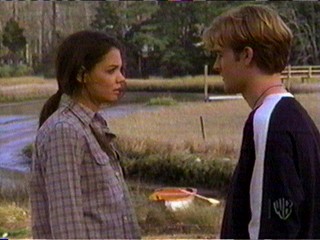
Then this happened:
This is James Van der Beek, which is a silly name, a.k.a Dawson Leery, which is less silly unless he’s attempting to cry or being Dawson.
Okay, so before I get started, let me just head off all the Dawson’s Creek fanatical outcry by saying this: I didn’t hate the show. But I would have loved it a lot more if it had been called Pacey Witter’s Whiny Distraction, or perhaps My Best Friend is an Annoying Unlikable Know-it-all: The Pacey Witter Story. Because, let’s face it: This show would have tanked without Pacey. We not only liked him, but unlike the rest of the crew, HE ACTUALLY DID STUFF. He even went so far as to evolve naturally, and much to the dismay of ever other character not named Joey, grow up. Better yet, my burgeoning man-crush on the cheeky Joshua Jackson aside, Pacey led us to Fringe, which is better saved for another blob because my one-thousand word review is somewhere around a manuscript at this point. It needs edits. And more pictures.
Here’s a picture:
Will someone please tell me who I am?
We’re definitely Michelle Williams fans. How can you not be? But what the hell was the deal with Jen Lindley? It’s as if the writers carried her forward as if she were a cup of hot coffee that may, or may not, have too much sugar and/or cream, or might not have even been coffee at all but merely an empty cup that was neither hot nor cold nor just right. She crushed on Dawson until he wanted her, then bailed (rinse and repeat a few seasons later, then once more for good measure), was a cheerleader for a minute, went from bad girl to wanna-be-good-girl to bad girl so frequently and efficiently that watching Miley Cyrus or Lindsay Lohan is a rather tame affair, pined for a gay guy, had some weird Dawson-esque love/run/don’t love/love thing with a weepy eyed kid named Henry, befriended every most hated character on the show and wondered why no one understood her, was an on-again off-again alcoholic weirdo, was a music dj out of nowhere who did her thing and then suddenly just didn’t, tried to have sex with pretty much every character willing (or even unwilling, actually), and had the most inconsistent, indecisive, and outright awful hair of the entire show.
And why didn’t anyone on this show ever get carded? I mean, sure, they all looked like they were pushing thirty, but somewhere, someone had to have had their doubts, yeah? Or at least a love for keeping their business open?
Then there was Andie, whose endearing fast-talking, brainiac, neurosis somehow morphed into a psychopathic raging mental breakdown out of nowhere, despite the fact that she was dating Pacey, who, as mentioned, was the gold in this pawn shop classic. Before we could come to grips with this surprising about face, she was carted off to an institution, to be locked up with Michael Meyers I presume, and fell in love with some random crazy guy who couldn’t at all have been as snarky as Pacey and his I Call Everyone By Their Last Name wit. Which would have been fine if they hadn’t brought her back, because I suddenly didn’t care. She just became another character on the Let’s Annoy Pacey Because He’s the Heart of the Show dog pile.
Grams was cool. I liked her. She’s my defacto Ms. Ruth in The Storyteller.
Dawson’s parents were weird. Not in that, Every Kid’s Parents way. Just in that I Feel Sticky Because You’re There kind of way.
Audrey waffled between annoying and acceptable. As with every other female on the show, she was only acceptable while dating Pacey. Anyone notice how crazy these girls got without Pacey in their lives?
I liked Jack when he played football. College Jack made me want to pull ears off bunnies.
Oh, Doug. Pacey knew all along, didn’t he?
Some chick shows up, named Eve, right? Looking for her mother, or something. Gets Dawson all worked up, because, well, because he’s Dawson. Makes herself a nuisance. Seems loony. Then she’s all I’m So Sad Because Family, and we’re supposed to like her. Then she leaves. We find out who her mother is. Then it’s never mentioned again. Right. That.
Katie Lee Holmes married Tom Cruise. I mean, is it possible to look past that? And can anyone remember Joey’s profession? I don’t think she can either.
Interestingly, there are several more characters, plot points (what’s that? Dawson’s dad had a contract dispute? KILL HIM DEAD NOW AND HAVE DAWSON BECOME EVEN MORE INSUFFERABLE THAN EVER AMEN PLEASE.), blah blah blah I could ramble on about, but it only now occurs to me I have not even mentioned this:
Dawson, what’s the deal with your hair?
No, seriously. Your hair is just … it’s just awful.
I mean, it hurts just to look at it. This is why I can’t be with you. I know you don’t understand, on account of being Dawson and all.
Holy hell, you hair is so awesome. I totally love you.
What have you done, Dawson? His hair! You messed … oh, wait. Never mind. Jealous.
I think that sums it up. I mean, sure there were a few instances where we were worried about Pacey hair (the goatee comes to mind) and whether or not Joey would choose it over Dawson’s weird feathered 80’s locks, but dude had a boat, became a chef, slept with his teacher, dated a psychopath, traded stocks like a boss, and never once did his hair look out of place. What did your hair do, Dawson? Nothing. NOTHING. Maybe How Pacey’s Hair Won the Internet would have been a better title.
As mentioned, I didn’t hate this show. The first three seasons were pretty okay. After that, the show just annoyed me. There are reasons I don’t want to be a teenager again. Dawson’s Creek nailed all of them, and added a few for good measure. It’s the only show we’ve thus far watched that I could not wait to finish. I just wanted it to end. And it haunts me still.