Ducky Thomas Goes to Richmond

This is Ducky Thomas:


This is Ducky Thomas. He is a duck named Thomas.


Recently, Ducky Thomas had an adventure.  He went to Richmond, Virginia on a trip.  It wasn’t the grandest of trips, but it was exciting all the same.  He went on this journey with me, as I took to the town as a speaker at the James River Writers Conference.  Unfortunately, however, he did not attend the conference, as it cost quite a bit of money to pay the way for an attendee, and, well, ducks are just not allowed in the library.  So, while I was away, he manned—er, ducked–the hotel room where he…well, I suppose I should let his words speak for themself:

“I’ve never gone on a trip before.  For that matter, I’ve never gone anywhere before.  Before this weekend, I had only been out of the bedroom, where I stay, just once to sit on Zach’s desk.  He said he wanted to take my picture, which was okay with me, but ducks aren’t much on make-up, and don’t often pose for pictures, so I was a bit nervous about it all.  And that was just for a picture!  Imagine how I felt when he asked me if I wanted to go to Richmond! ‘Golly!’ I had exclaimed.  ‘I don’t even know what a Richmond is, but I sure do want to see it!’  So, sure enough, he told me I could go, and went to something called, ‘Target’–which I believe is not far away, but must be a magical place, seeing as how he returned quickly with a wonderful black traveling house with wheels for me to ride in.  Who knew there were such things in the world!  It had plenty of room for me to rest comfortably, and I was able to keep all of Zach’s belongings safe during the trip–though I do have to admit that the darkness made me sleepy, and aside from some bumpy moments, I slept quite a lot.  Fortunately, no one tried to open the house, and before I knew it, Zach was opening the door and I opened my sleepy eyes to see something amazing!  It was a brand new place, much bigger than the bedroom I’m usually in!  And, it had a really big window that let me see one of the most amazing sights I have ever seen!  Ever ever!


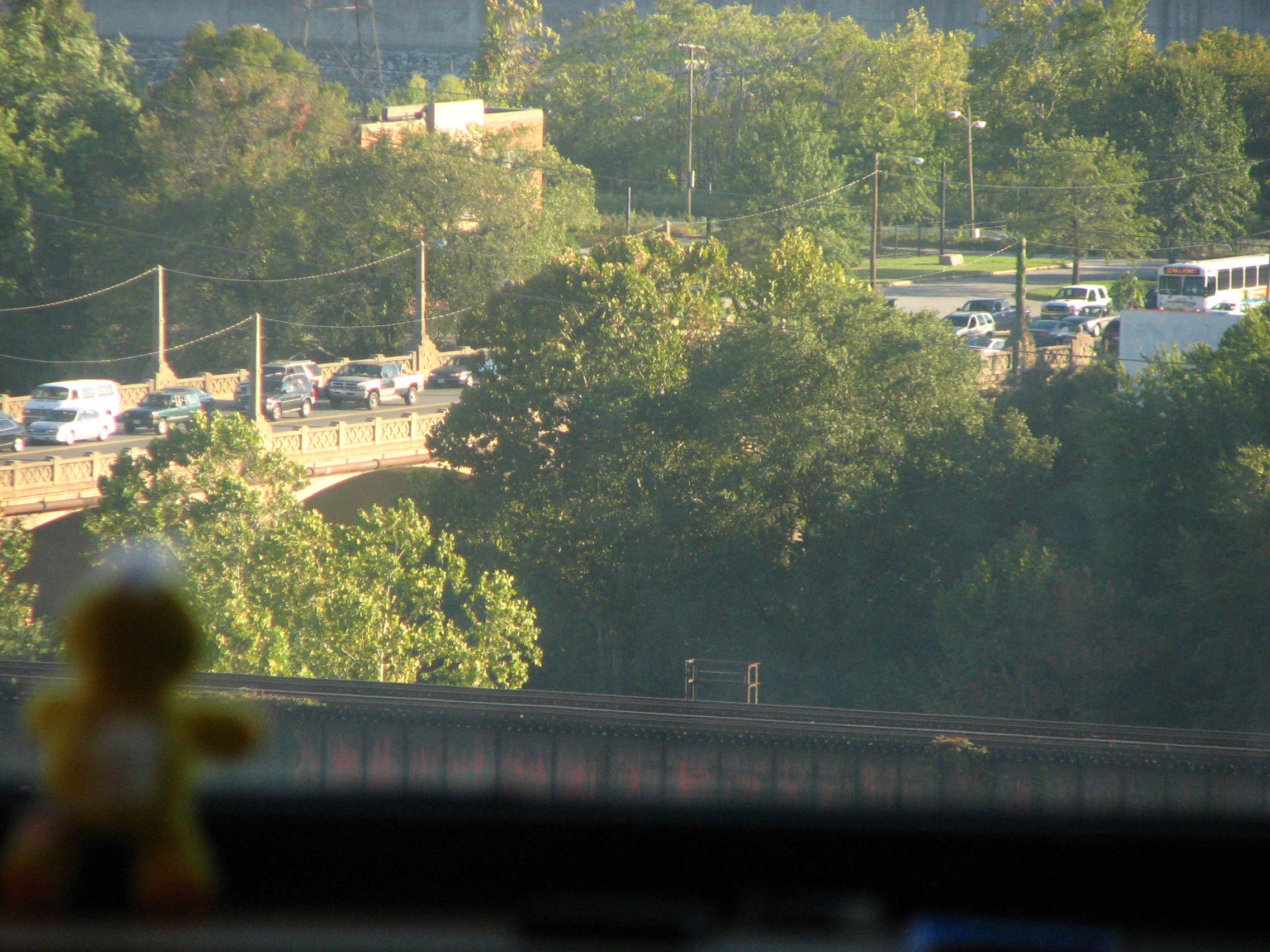
This is what a Richmond looks like!


There were lots of what Zach called, 'outtomobeels.' That's the rolling things over there!


Whoa. Richmond.


Well, boy, was I excited!  I just sat in that window ALL day long!  And when it got dark, everything got all sprinkled in little lights everywhere.  It sure was incredible!  Zach was gone most of the time, where he said he was spending time with the Righter people, who like to talk about the Righter things.  Apparently, Zach knows something of this Righting, because he was very excited about all that he had done while he was there.  He was almost as excited as I was about seeing the Richmond all day!  Well, anyway, he told me that he sat on a panel about religion, which does sound kind of unpleasant, and maybe a little painful, but he didn’t seem to be bothered by it at all, so I guess it’s not that bad.  I listened as he talked about his adventures that day, and then the next day too.  He spent an awful lot of time with the Righters, where they talked about the Right way to do things, I suppose.  It’s good that people try to be Right, I’ve been told, so it’s even better that they have conferences to discuss it.  Zach said that the people there liked him so much that they bought all of the books that were for sale!  Yay for Zach!  He said that there were more panels that he sat on (I still don’t know why he sat on them, but, I’m just a duck, and will not understand, I guess).  There was one on Fan Tah See, which is, according to Zach, about make-believe stuff that is in stories, and sometimes has dragons, magic, and shallow vampire characters that only little girls like.  And then there was the one on Die A Log, which is a funny name to me.  I mean, from what I could tell from my perch over the Richmond, it seems to me that logs–which I know from a television show that I watched with Zach, come from trees–are very pretty, and very helpful to things.  I can’t imagine why anyone would want to kill one.  But Zach made it sound kind of delightful, and said that the Righter people asked a lot of really neat questions about Die A Log that he, and two other Righters by the names of David L. Robbins, and Lauren Oliver, answered.  I don’t know them, but they sound neat!

Well, he just seemed to really enjoy his time, which was wonderful to hear, because I was beginning to worry that I might be having too much fun looking at the Richmond–more fun than Zach–and that made me feel bad.  I didn’t want Zach to miss out on the fun, either.  He did sit with me for a while watching the sun rise one morning, which was really neat!  I had never seen that before either!  I was glad he got to see it too, though he had to leave before I could tell him that.  But I think he already knew.  So, I guess that was pretty much it, after that.  Zach said he met lots of new people, and that there was something funny about something he said the Righters called a, ‘humanzee.’  I don’t know what that is, but as I’ve said, I’m a duck, and I don’t really know too much about things. Zach told me, as he was putting me back in the black, boxy house, with wheels that he hoped that he could keep in contact with his new friends, and that some of them were really nice, and pretty good Righters that needed to simply believe in themselves a bit more.  I liked the way that sounded, and so I just smiled at Zach, closed my eyes, and fell asleep.  The next thing I knew, we were home again.

I don’t have to stay in the bedroom anymore.  Now I get to spend time on Zach’s desk while he does his Righting.  It makes me happy. But not as happy as knowing that Zach has promised to take me to other new places too!  I can’t wait!


It's a big world for such a small duck.


A Haunting in God’s Office

A few days ago, I announced that Flutter: An Epic of Mass Distraction, had been given the release date of October 1, 2010.  I also promised some material from that forthcoming work.  So, today we’ll take a peek into one of the more bizarre, and unfocused, locations in the whole of the scope of Heaven: God’s Office.  Yes, even God has an office.  And he has a picture of you in it.  Well, you, and another few billion people.  Also, his office is haunted, though the spirit in question isn’t much of a menace.  A whiny, moody, ghost, true, but not menacing.  This scene also included the arch-angel of dreams, Morpheus, who has a lot to live up to, given that his identity was, in effect, swiped and utilized in the Matrix.  So, anyway, here  you go, with no further set up.  Enjoy and feel free to comment!

God’s office was infinite.

            This was as much a product of His love for a spacious workspace, something tolerable to His love for plastic plants, and pictures of loved ones—and there were billions of those—as it was a universal necessity.  To say that a limited, defined, space would produce an undesirable amount of clutter on His desk would be a gross understatement.  It would, in fact, produce nothing short of Armageddon.

            The prospect of the utter obliteration of humanity aside, God also had a fascination with aesthetics.  Further, He had a fascination with structure.  And though He was still working to understand the finer nuances of Feng Shui, and how to best apply such principles to an infinite space, He was quite fond of His space, and had plopped in a few million bookcases, end tables, chairs, and trinkets for good measure. 

It was good, as He might say.

            With the exception of Morpheus, the only angel to have earned visitation rights, no spirit—human or angel—had ever stepped foot in God’s Office.  The only company He kept, and the only soul that had ever occupied this luxurious space at the same time on a regular basis, was a fraction of His being—a splinter of Self created purely as a means to combat His galactic boredom—known as the Holy Ghost.  This was as much a product of His affinity for the Holy Ghost, as it was that it simply could not go anywhere else.  Ever.  In a way, the Holy Ghost was God’s personal pet, imprisoned in an infinite office, bound to amuse its creator, and as complicated a being as a jello mold encased in a blanket, providing the jello was bitter and reeked of teenage angst. 

            WHAT DO YOU THINK?

            The Holy Ghost, contemplated God.  “Woooo?” it asked.

            God looked at Himself, and balled tiny fists.  WHY SHOULDN’T I BE?  MORPHEUS THINKS THIS BEST, AND I RATHER AGREE WITH HIM.

            Though it lacked a defined shape, and form, to any degree, it did sparkle quite a lot, if only dully.  And though any action in which it partook was typically not entirely visible to any eyes short of God’s unless it wore the Holy Sheet, the Holy Ghost shrugged.  It liked to shrug.  Being in God’s presence had cemented the need for a quality shrug.  “Woo, wooo, wooo,” it replied.

            PLEASE STOP THAT, said God.  IT’S NOT VERY BECOMING.  FRANKLY IT’S ENTIRLY UNECESSARY, AND MORPHEUS HAS NO IDEA WHAT YOU’RE SAYING.

            “Oh, don’t worry about me,” Morpheus smiled dimly at the Holy Ghost.  “I’ve no desire to be a bother.  But, for the record, I think You look absolutely adorable.  Though I do admit to simply being happy just to be able to see you, for a change.”

            God stretched his tiny arms outward, eyebrows raised to the translucent specter in His seat.  “SEE?  ADORABLE.”

            The Holy Ghost sighed somewhere from the depths of the fourth level of Heaven, and slumped further into the seat.  “Fine.  Whatever.  I just don’t get why you can’t be the old man with the beard, and all, you know?  It’s like you’re more You that way, and stuff,” it moaned.

            I’VE BEEN THE OLD MAN WITH THE BEARD BEFORE.  HUMANS DISREGARD ANYTHING THAT PLAYS TO A STEREOTYPE.  THEY HAD ME COMMITTED.  RUINED A PERFECTLY GOOD SABBATICAL.  I’VE NEVER FELT SO SHORT-CHANGED.

            “That’s what she said.”

            WHAT?

            “I believe,” Morpheus interjected, “that our transparent friend was curious as to how long you stayed, during that unfortunate time?”

            The Holy Ghost shrugged.  “Whatever.”

            WELL, I LEFT IMMEDIATELY, OF COURSE.  WHY DO YOU ASK? 

            “Well, it’s, like, you forget who you are, and all, when you’re there too long, you know?”

            God snorted, allowing a simple laugh.  I MOST CERTAINLY DID NOT FORGET WHO I WAS.  I SIMPLY NEGLECTED TO REMEMBER EVERY FACET OF MY BEING.  A CAVERNOUS DIFFERENCE OF INEVTIBLE RESULTS THERE.  SUCH THINGS CAN HAPPEN WHEN YOU DABBLE IN HUMANITY.  FILL AN EMPTY GLASS WITH WATER, AND SEE HOW LONG IT TAKES TO FORGET THAT IT WAS ONCE EMPTY.  HUMANITY IS NO DIFFERENT.  THE TRICK IS NOT TO STAY TOO LONG.  OR TO FILL THE GLASS TOO MUCH.  I’VE TRIED TO GET HUMANS TO UNDERSTAND THIS, BUT IT SEEMS THEY ARE FAR TOO BUSY DEBATING THE ORIGINS OF THE EGG TO SEE THAT THE CHICKEN WAS NEVER INTENDED TO BE SEPARATE FROM IT AT ALL.  EITHER WAY, I’LL BE FINE.  He nodded to Morpheus.  I’LL BE FINE, he repeated.

            “You’re so blind!  You deserved to be accused of insanity!  Jeez!”  The Holy Ghost triumphantly crossed its arms, and, if possible, slumped further into the chair.

            I DID NOT DESERVE TO BE ACCUSED OF INSANITY.  IT WAS SIMPLY THE RESULT OF A POOR CHOICE IN WARDROBE, AND A LACK OF SELF-AWARENESS.  THIS TIME WILL BE DIFFERENT.  YOU WILL SEE.  THEY WILL NOT DENY A CHILD HIS VOICE.

            The Holy Ghost rolled its eyes, and, being short on further, more visible, dramatics, offered a huffed, “Whatever.”

            God considered the Holy Ghost, and placed His small hands on His small hips.  DON’T SAY, ‘WHATEVER,’ TO ME.  I KNOW WHAT I’M DOING.  THIS IS A VERY DELICATE SITUATION, AND IT REQUIRES A DELICATE VOICE.  IT WILL ALL WORK OUT FINE, YOU’LL SEE.  ONCE I’VE MET WITH IZZY, AND LOCATED OUR WAYWARD SOUL, I CAN RETURN AND DEAL WITH THE OTHER PROBLEMS AT HAND FROM HERE.  IT’S SHORT WORK.  MORPHEUS, YOU WILL CARE FOR THINGS WHILE I’M AWAY.  Morpheus offered a dramatic bow.  I WILL BE SET UP SOON ENOUGH TO MONITOR MATTERS FROM EARTH. 

            “That should be awesome for us all, I’m sure,” muttered the Holy Ghost.

            THINGS WILL BE FINE, AND I’LL RETURN AS PLANNED.  YOU’LL SEE.  DON’T WORRY.  I KNOW WHAT I’M DOING.

            “Of course you do,” replied Morpheus, remaining prostrate.  “You are God.  God knows all.”

            In response, God simply nodded.  He was not often prone to doubt, at least none that the universe at large could be made aware of, but He had to admit that this situation was a difficult one, and had already proven itself to be tricky to set in motion precisely the way He desired.  INDEED I DO.  NOW, He said to the Holy Ghost, YOU WILL REMEMBER TO DO YOUR JOB AS INSTRUCTED?  IT IS VITAL THAT YOU DO.

            The Holy Ghost shrugged.  “Whatever.”

            God raised His eyebrows. 

            “Yeah,” shot the Holy Ghost, “I said, ‘whatever,’ didn’t I?  We’ve only been over it a bajillion times.”

            After a moment, God nodded, raised a small hand, and waived a farewell to the Holy Ghost, and to the nearly doubled-over form of Morpheus, feeling slightly at odds with the feeling of physicality.  It had been close to a hundred years since He had last taken a trip to earth.  Even for God, that was a lengthy bit of rope.  BE WELL, THE BOTH OF YOU.  I SHALL RETURN WHEN TIME IS IN MY FAVOR. 

            In a physical sense, God turned to a nearby wall, stepped into an open tubular portal, and shot out of sight in a whoosh of air.  In the infinite expanse of the quite unphysical realm of God’s Office, however, He simply vanished in a trickle of rippled light.

The Holy Ghost looked at the now empty space where God had stood, shrugged, and began a search through God’s desk for a crossword puzzle to keep it occupied. 

“This is all very exciting.  He left you a job, did He?”

“Yeah,” said the Holy Ghost.  “Some letter I have to give to some angel when he gets here, or whatever.”

“Truly?  How wonderful.  A message of grand importance I gather?”

“Not really.  Just a stupid message that doesn’t really make a whole lot of sense at all.  Typical.  You wanna see it?”

“Well, I wouldn’t presume to corrupt the job left to you, but, maybe for the sheer fun of exploration, let’s give it a look, yes?”  The Holy Ghost pulled a folded letter out of a top drawer, and slid it across the desk.  “Well,” said Morpheus, reading the short note.  “Now the fun truly begins, doesn’t it?”

“Whatever.”

The Electronic Age Doesn’t Care if You Have Pages

The other day, I wrote a blog on the Mercury Retrograde Press site about the advent of technology, and what it means to the book buying world.  In a blatant display of laziness, and continued promotion of ME, I offer it here as well (though I highly recommend a trip to the MRP site!!!).

Here it be:

So, I’m a reader, just like you, and I’ve spent the better part of my life collecting books, selling them to used book stores when I have too many, and then investing the better part of the next few years desperately trying to buy them back.  I like being able to peruse my shelves, touch the spines, journey through the tactile memories of when I first read them.  I enjoy the feel of the page against my fingers, love the process of turning my way through another world (gently…do not bend!), and will never tire of falling asleep with the solid weight of a tome against my chest.

I cannot fathom a life without books.

But the Electronic Age can.  It can imagine a world in which paper is rendered irrelevant, and bookshelves are replete in unwatered plants, and pictures of loved ones, with nary a book to set them apart.  It can imagine a world in which an epic is downloaded, where heroes battle nemeses not across a page, but through the pixelated kaleidoscope of a computer screen.  It wants your books, and no amount of kicking and screaming will turn it away.

And you are kicking and screaming, aren’t you?

Just ask any book aficionado, and you will receive a diatribe against the Machine, unlike any this side of John Connor’s rebellion.  “No way,” they will say, just shy of screaming.  “The book will always exist.  People like to hold a book, to bend a book, to flip pages, and remove dust jackets!  This whole e-publishing thing is a fad, meant to placate the lazy, techno-geeks amongst us.  Just a fad, that’s all.”

Mhm.

To a degree, though, they are right; and to a greater degree they are drowning in a shallow pool of denial.  Motoko Rich of The New York Times recently wrote a splendid article about the rise of the e-book, in which he spends a very short amount of time extolling a very large amount of readable information, all of which is meant to help us understand the financial ramifications of the e-book vs. the traditional paper-bound.  It’s a fantastic read, and is quite the enlightening journey through the numbers involved.  And, in the end, it’s difficult to argue to point he makes.  The current economic downturn has everyone thinking cheap, lean, and efficient.  The publishing industry has been hammered over the past two years, and is reeling in one direction, or another, hungry for any means by which to gain a better foothold on the future.  The truth is–whether we like it or not–e-books are a more cost-effective process.

Here is the crux of his cost-based argument for e-books:

On a typical hardcover, the publisher sets a suggested retail price. Let’s say it is $26. The bookseller will generally pay the publisher $13. Out of that gross revenue, the publisher pays about $3.25 to print, store and ship the book, including unsold copies returned to the publisher by booksellers.

For cover design, typesetting and copy-editing, the publisher pays about 80 cents. Marketing costs average around $1 but may go higher or lower depending on the title. Most of these costs will deline on a per-unit basis as a book sells more copies.

Let’s not forget the author, who is generally paid a 15 percent royalty on the hardcover price, which on a $26 book works out to $3.90. For big best-selling authors — and even occasionally first-time writers whose publishers have taken a risk — the author’s advance may be so large that the author effectively gets a higher slice of the gross revenue. Publishers generally assume they will write off a portion of many authors’ advances because they are not earned back in sales.

Without accounting for such write-offs, the publisher is left with $4.05, out of which it must pay overhead for editors, cover art designers, office space and electricity before taking a profit.

Now let’s look at an e-book. Under the agreements with Apple, the publishers will set the consumer price and the retailer will act as an agent, earning a 30 percent commission on each sale. So on a $12.99 e-book, the publisher takes in $9.09. Out of that gross revenue, the publisher pays about 50 cents to convert the text to a digital file, typeset it in digital form and copy-edit it. Marketing is about 78 cents.

The author’s royalty — a subject of fierce debate between literary agents and publishing executives — is calculated among some of the large trade publishers as 25 percent of the gross revenue, while others are calculating it off the consumer price. So on a $12.99 e-book, the royalty could be anywhere from $2.27 to $3.25.

All that leaves the publisher with something ranging from $4.56 to $5.54, before paying overhead costs or writing off unearned advances.

But that’s not the only reason that we, as the book buying populace, need to come to understand, and even to a degree, appreciate the reality of electronic publishing.  Just look around you.  We live on the computer.  We’re on Facebook, or Twitter, playing computer games, writing, or reading documents for work, getting our news, watching videos on You Tube, or catching up on shows on Hulu.  We have the I-phone, blackberry, the I-Pad (that still hurts to say), and various other mobile devices that have essentially become mini-mobile-pc’s that dominate our days.  How many times have you gotten stuck playing that ridiculously awesome paper ball in the waste basket game?  Generations of children are being raised on this as a normal facet of society, and no amount of reminiscing about rotary phones will change what the future holds.  Computers–the Electronic Age–is here, and it stands to reason that books will follow.  Actually, books must follow.  If we want people to read, then we have to give in to the conveniences they so desperately seek, and allow that books won’t exist if publishers aren’t around to print them.

Me?  I still want to sprawl out on a lawn chair at the beach with a paperback.  I still want to stick my nose in a book, and smell the scent of paper.  And I still want my dream library, wall-to-wall, floor-to-ceiling, replete with as many cobwebs as they can build.  Now, if you’ll excuse me, I need to go flop on the bed, with my copy of The Magicians, and read until I fall asleep.

The Writing Life

(I wrote this post on the Southern Author’s Blog, so it’s a bit of a duplicate)

I haven’t been writing for the entirety of the limited experience that I call, “life”. I mean, well, obviously I wasn’t writing in the womb, nor did I pop out with pen and paper and get to scribing my experiences in utero. I suppose that would have been quite the story, if not, an altogether painful experience for my poor mother. So, what I mean to say, is that, though I may have spent the majority of my capable time on this earth writing, I have some lingering years remaining that offer no insight whatsoever into my life as a writer.

What is that supposed to mean? I take it to mean that I need more coffee.

The thing about life, see, is that life, in and of itself, is a story. Not the words you put on paper (or screen in this modern age), or in the ideas floating about the nether regions of your mind, plucking you awake at the most obscene hours of the night, but in every aspect of every person in every day that you live. Writing is, more or less, the centrifuge to the swath of stories we swim through on a daily basis. I’ve been told many times that, “there is no story that has yet to be written,” and to some degree I get the concept of that statement. To some degree, yes, the stories that are written are nothing more than variances of stories that have been around for centuries. Stories that your grandfather told you on cold nights by the fire, stories that you heard while eavesdropping on that squabbling couple in the cafe, stories that were chipped in tablets and handed down (or succinctly dropped on the floor and cracked into peices by that snarky caveman-esque editor with no appreciation for the man-mammoth-woman love triangle). But in each familiar story, in each tale that rings of familiarity, there in a unique perspective, a unique slant, something that only happened that one time.

Oddly, it took me a while to see this. I had to actually look up from the page, so to speak, and take a nice long look at the world. I had to see how, in its persistent way, that life prodded the art of storytelling. Sometimes, as a writer, you become a bit insulated. A bit protected from reality whilst you delve into the preferred insanity that is your chosen world of fantasy. It’s safer there. You can do what you want. You can kill someone, feel remorse, and move on without consequence. You can encourage affairs, you can win the lottery and stick your tongue out at the world, you can rule the moon, you can take the fragile psyche of a beaten soul and thrash it upon the ground like a small child who is curious to see what happens to the turtle inside the shell once it is broken. But you’re safe because it isn’t real. It’s just a story, and they are all just characters bent to the will of your madness.

I heard it stated that every writer has within them a musician wishing to break out (actually I ready that today from a source I’d rather never listen to again, but I liked it, so now it’s mine…bwahahaha!), and I have to agree. However, it would be irresponsible to music to claim that it resides within any one person. Stories, music, dance, painting, sculpting, they’re all art. They’re all the same. They are all the fabric of life. They all flow. And not one is inspired from within, nor do any reside there. Life is the art. Life is the song. Every life is a story, and in turn, every story is alive.

Ok, so the idea is a touch out there. It’s as inspired as it is insane (though there really isn’t a difference…all artists are insane with inspiration). It’s something out of a Russell Crowe, or Dustin Hoffman-type movie, but it’s true. It’s so very easy to forget that your little experiences, your seemingly insurmountable trials, your possessed frustrations are shared by all of those around you. We all feel a bit like Truman, trapped on the stage, the world as our audience…every so alone in our experiences. But the world is replete in repetition, and in shared experience. No, the mind of that person next to you is not yours, and their similarities are not as yours, but their story is like your story, only in variation, and that variation is enough to make it unique. We are bound by what we are: living creatures who wander like mobile trumpets, blaring our stories for the world to hear. You only have to listen.

Life is everywhere. So are the stories.

Go find them. It isn’t hard. They are waiting for you.